
Ceremony Honoring University Martyrs of the Third Imposed War; Dr. Fariba Mohammadi: Student Cultural-Sports Olympiads an Opportunity for Empathy and Post-War Social Reconstruction

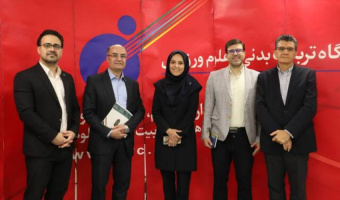
The webinar 'Ceremony Honoring University Martyrs of the Third Imposed War' was held with speeches from the Minister of Science, Research and Technology, the Secretary of the Supreme Council of the Cultural Revolution, and a group of university presidents and higher education administrators, including Dr. Fariba Mohammadi, President of the Institute of Physical Education and Sports Sciences.
Dr. Fariba Mohammadi: Student Cultural-Sports Olympiads an Opportunity for Empathy and Post-War Social Reconstruction
According to a statement from the Public Relations Office of the Institute of Physical Education and Sports Sciences, the webinar 'Ceremony Honoring University Martyrs of the Third Imposed War' was hosted by Allameh Tabataba'i University and featured the presence of Hossein Simaei Sarraf, Minister of Science, Research and Technology; Abdolhossein Khosropanah, Secretary of the Supreme Council of the Cultural Revolution; Vahid Shalchi, Deputy for Cultural and Social Affairs of the Ministry of Science, Research and Technology; and a group of university presidents and higher education administrators.
The session, aimed at commemorating the memory of university martyrs and examining various dimensions of the recent imposed war, featured speeches from a number of the country's scientific and cultural officials.
During the program, Dr. Fariba Mohammadi, President of the Institute of Physical Education and Sports Sciences, also delivered a speech.
At the beginning of her remarks, commemorating the memory of the country's martyrs, she said: "Today, in this gathering of esteemed intellects, alongside university presidents and higher education centers, the country's scientific and cultural administrators have come together while our hearts still bear the grief of the victimization of people who, without any refuge, were targeted by violence and unethicality — especially innocent children, and specifically the oppressed children of Minab, whose names must always be kept alive in all forums so that this injustice is never forgotten."
Referring to the attacks on sports facilities during the recent war, she continued: "During the recent 40-day war, according to official reports, more than 203 sports venues in 17 provinces of the country were attacked. This number is not merely a statistic; it is a clear sign of the targeting of the social infrastructure that shapes the next generation. The fundamental question is: why sports facilities? Naturally, these spaces are not merely places for physical activity; they are hubs for the formation of social trust, collective identity, and shared experiences of the younger generation."
The President of the Institute of Physical Education and Sports Sciences added: "In universities, among students, sport is a platform where — beyond physical ability — character, responsibility, a spirit of cooperation, and collective living are formed. A clear example is the 12,000-seat Azadi Stadium — a space that for thousands of young people is not merely a place, but a part of their memory, identity, and lived experience. When such spaces are targeted, what is destroyed is not merely a structure but the collective memory and the horizon of hope of a generation."
Mohammadi, emphasizing the role of sport in strengthening social capital, stated: "Sport, as a tool of soft power, plays a key role in strengthening national identity, social cohesion, and creating vitality among students. Even despite limitations and economic challenges, targeted investment in this field can have deep and lasting effects on the university environment."
She also referred to planning for the post-war period: "For the post-war period, through joint planning with the Physical Education Department of the Student Affairs Organization, we have developed a cohesive design for holding a student sports Olympiad. This event will certainly be one of our powerful tools for the post-war period for students, and it is an unparalleled opportunity to create a network of human and social connections by combining education, sports, and empathy — in which life skills, cooperation, and national cohesion are practiced through sport, the spirit of solidarity and resilience in the face of difficulties is strengthened, and the new generation benefits from the heritage of Pahlevani and Iranian ethics."
The President of the Institute of Physical Education and Sports Sciences concluded by asking university presidents to play a role in strengthening students' social capital by leveraging the capacity of sport, saying: "I respectfully request the esteemed university presidents to recognize this valuable capacity, to utilize sport as an effective tool for enhancing social capital and confronting cultural threats, and by providing the necessary platforms, to facilitate the effective, widespread, and targeted participation of students in intra-university sports Olympiads and the national student cultural-sports Olympiad this year."
Your Comment :